Supporting Cognitive Development
Domain Introduction
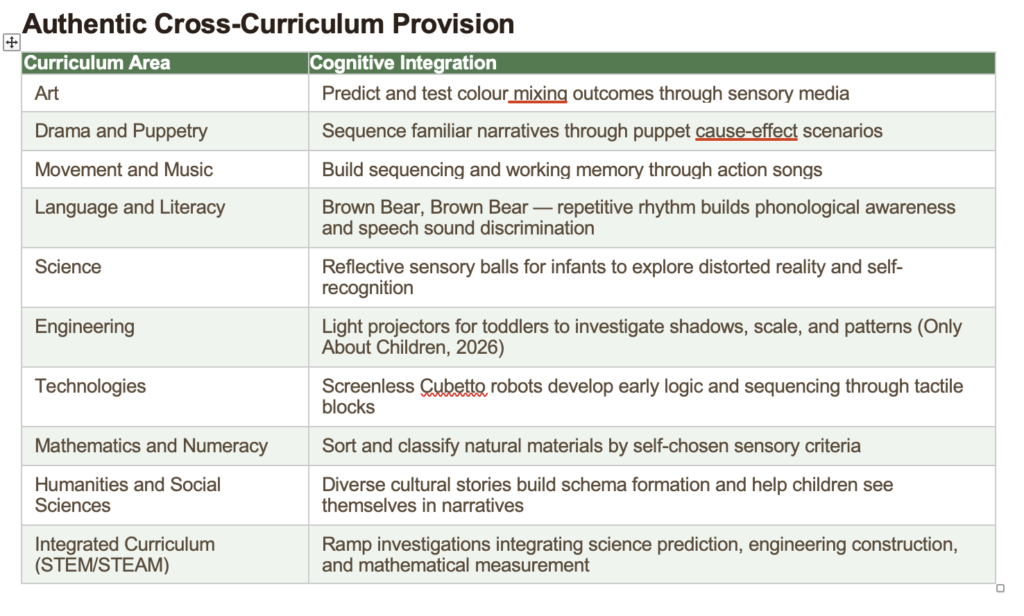
Cognitive development encompasses how infants and toddlers think, reason, solve problems, and construct meaning. Piaget’s sensorimotor stage positions children as active knowledge-builders progressing from reflexive responses to symbolic thinking by 18 months (Garvis et al., 2019). The brain selects and reinforces neural networks through functional validation of synapses driven by rich, repeated experience (Harding, 2023). Literacy — defined as the ‘capacity, confidence and disposition to use language in all its forms’ (AGDE, 2022) — is embedded across all cognitive provision.
Teaching Competencies
• Observation and documentation: Recording cognitive behaviours to plan responsive next steps (Dean et al., 2019)
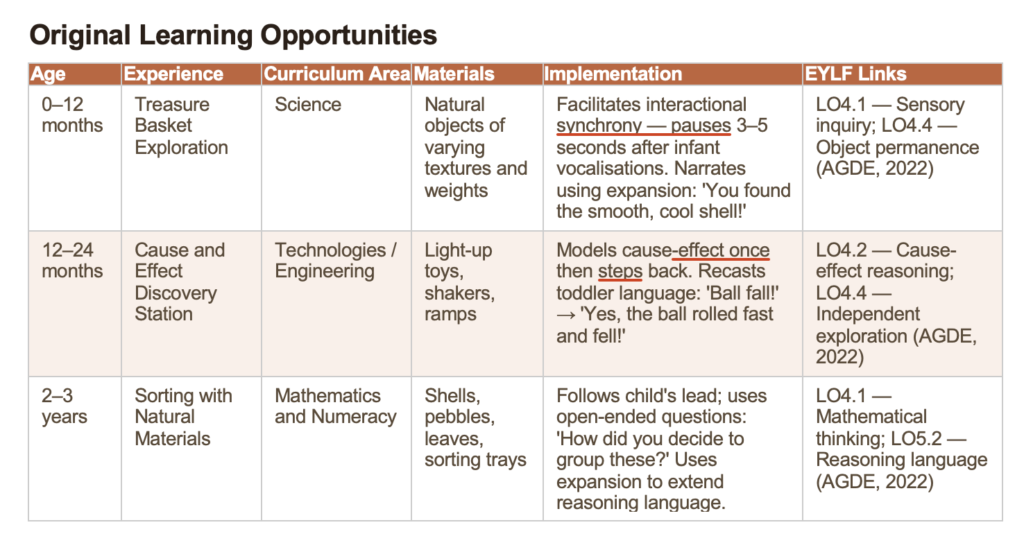
• Expansion and recasting: Adding vocabulary to children’s words — child says ‘rough,’ educator responds: ‘Yes, that mouse has rough, scratchy paws’ (Kaywork, 2020; Weadman et al., 2021)
• Interactional synchrony: Applying 3–5 second pause after mirroring infant coos to simulate conversational structure (Kaywork, 2020)
• Curiosity modelling: Demonstrating genuine inquiry to position problem-solving as valued
• Minimal intervention: Stepping back to allow independent persistence and self-correction (Dean et al., 2019)