Fostering Emotional Development
Domain Introduction
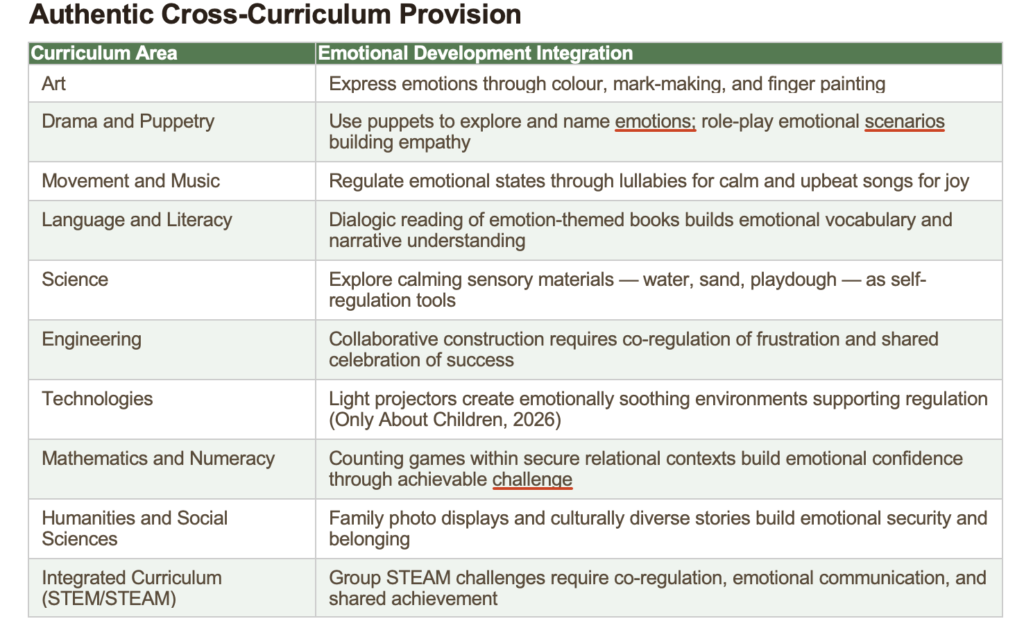
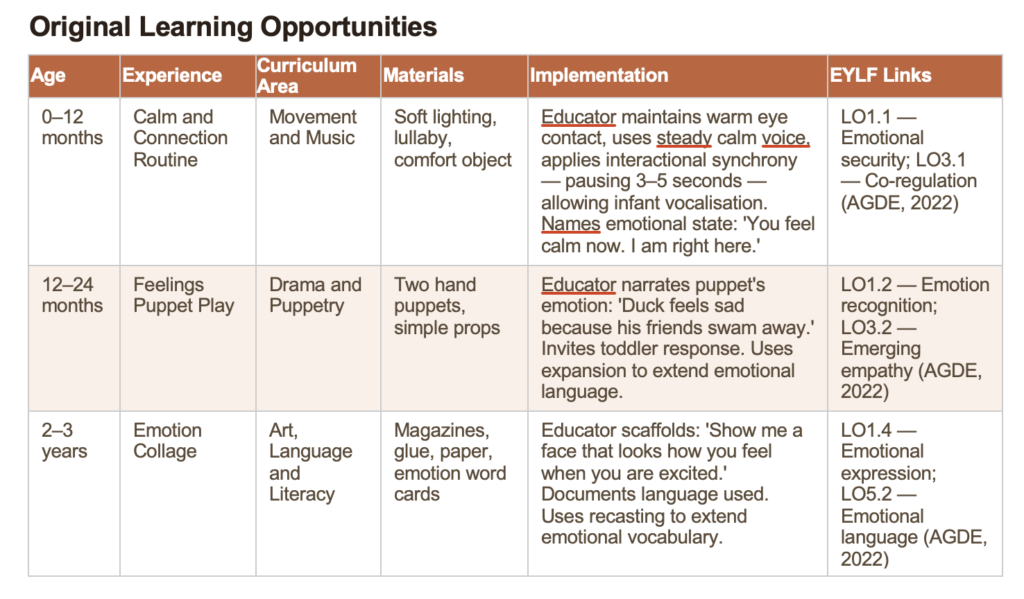
Emotional development encompasses the capacity to experience, regulate, express, and understand emotions, and to form secure relational bonds. From birth, infants communicate emotional states through facial expression, vocalisation, and body movement — and the quality of adult responses directly shapes the brain’s developing stress-response architecture (Garvis et al., 2019). Bowlby’s attachment theory establishes that secure, consistent caregiving is the neurological precondition for emotional regulation and resilience (Kearns, 2020). By 18 months, toddlers identify basic emotions through social referencing; by three years, emerging self-regulation and empathy reflect increasingly sophisticated emotional competence (DEEWR, 2016). The EYLF V2.0 (AGDE, 2022) links emotional development directly to Outcome 3 — wellbeing — and Outcome 1 — identity. Co-regulation, where the educator’s regulated presence actively supports the child’s return to calm, precedes self-regulation by years, making educator emotional literacy a professional necessity.
Teaching Competencies
• Emotional attunement: Reading and responding sensitively to emotional cues — soothing distress, matching joy — communicates all emotions are safe and accepted (Kaywork, 2020)
• Emotion labelling: Naming emotions simply — ‘You feel frustrated. That lid is really tricky’ — builds emotional vocabulary (Dean et al., 2019)
• Co-regulation: Maintaining calm presence during dysregulation using steady voice and warm proximity to scaffold child back to equilibrium (Masterson, 2018)
• Emotion coaching: Validating and problem-solving emotional experiences — ‘It is okay to feel sad. What could help?’ (Garvis et al., 2019)
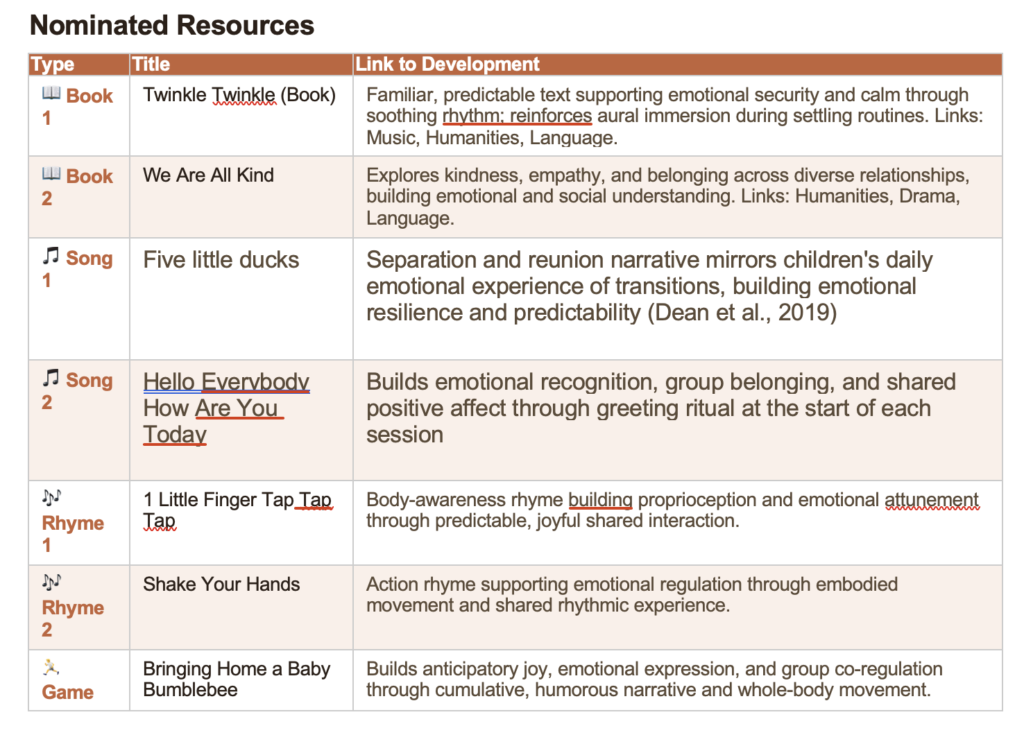
• Consistent routines: Predictable daily rhythms reduce anxiety and provide emotional safety (AGDE, 2022)