Introduction to Teaching in Infant & Toddler Education
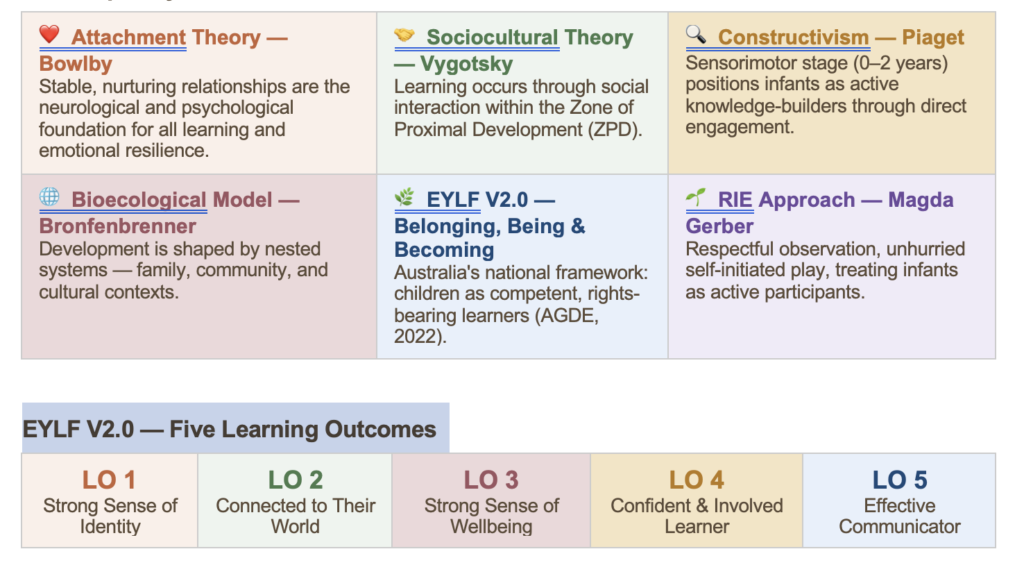
Children at this stage learn through sensory exploration, movement, communication, and safe interactions with familiar adults (Kearns, 2020). Contemporary practice integrates attachment theory, sociocultural models, and bioecological systems theory to view learning as a co-constructed process occurring within secure, culturally situated relationships (Arthur et al., 2024; Garvis et al., 2019). Piaget’s sensorimotor stage further positions children as active constructors of knowledge through direct environmental engagement. Critically, intentional instruction in language structures — phonology, syntax, and semantics — is essential given identified gaps in ECT oral language preparedness (Weadman et al., 2021).
In Australia, the EYLF V2.0 embeds these theories in national policy, framing children as competent, rights-bearing learners and educators as co-constructors of curriculum through intentional teaching, emergent curriculum, and responsive caregiving (Arthur et al., 2024; Pendergast & Garvis, 2023).
Contemporary Theoretical Frameworks: